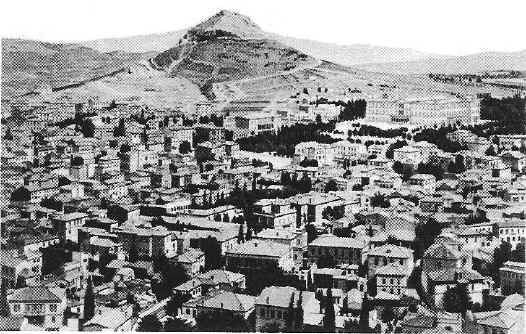
Athens at the time of the Olympic Games, 1896.
"Surrounded by a zone of hills, beyond which rise the mountains, and looking southward to the sea, Athens enjoys a climate that is at once continental and insular. The mean temperature is less variable than that of a continent, and more so than that of an island, in the same latitude. The spring and autumn are delightful, and the winters are mild, the mercury seldom falling below zero, which it has not touched once during twenty-two of the winters since 1840. Snow rarely falls in the plain, though it yearly whitens the mountaintops; fogs and frost are equally rare, and, upon the whole, the daily variations of temperature are less than those observed in most European towns, including Paris, Milan, Florence, and even Nice (the mean temperature in winter is 8,90 centigrade 47,50 Fahrenheit; in spring, 15,37 centigrade, 59 Fahrenheit; in summer 25,96, 78,50 Fahrenheit; in autumn 18,70 centigrade, 65 Fahrenheit; January and February are the coldest months (8,04 and 8,63 centigrade respectively); July and August the hottest (26,99 and 26,63 centigrade). The mean annual rainfall is 0,4059, and the moisture of the air is put at 74,3 for the winter; 64,9 for the spring; 49,3 for the summer, 65,2 for the autumn. These details are due to the kindness of M. Eginitis, the learned director of the observatory in Athens.) The summer is long, but in the very hottest months, July and August, the sea-breeze which sweeps across the Aegean tempers the heat and diminishes the dryness in the air to which is due the extraordinary tenuity and limpidity of the ambient atmosphere, the wonderful blue of the Attic sky, and the optical illusion which makes distant objects seem near." - Demetrios Bikelas